
Five Days Without Electricity And Other Negotiations.
Indian infrastructure is, above all, a social activity.

At first I thought this was about a fallen tree. It turned out to be about everything else.
A while ago, I wrote about the romanticization of farming and rural life — the soft-focus fantasy version that social media loves to package into sunsets, linen shirts and aesthetically framed cups of tea overlooking some conveniently profitable piece of land, that somehow never appears to have mosquitoes, paperwork or relatives involved.
Buying land in India, especially on a limited budget, quickly becomes an all-consuming exercise. Not just financially, but psychologically. Every available piece exists on a wildly different spectrum of accessibility, legality, topography, water availability, approach roads, neighbours, politics and possibility. You spend an absurd amount of time trying to explain to people what exactly you are looking for.
Not too isolated. But isolated enough. Accessible, but preferably in a way that discourages land ‘developers’ and politicians - most times, these two are interchangeable vocations.
Good water.
Some existing trees.
Motorable access, but not so motorable that everyone develops a sudden emotional closeness to your property.
Not fully wild, not fully tamed.
Close enough to a village. Far enough from everyone.
Mostly, you end up sounding unreasonable even to yourself.
Fortunately, I lucked out. The small group of local gentlemen helping me with the land purchase slowly became far more than brokers. In fact, land dealing is not even their primary profession, which I suspect is precisely why they remain sane, generous and trustworthy.
Somewhere along the process they became guides, interpreters, negotiators, occasional therapists and now, increasingly, friends.
Everyone comes from wildly different backgrounds. Different politics, communities, professions and temperaments. Yet somehow, in a way that feels deeply Indian, everyone finds enough common ground to build warmth and friendship around.
Which is useful, because I am slowly discovering that buying land in rural India does not mean ownership in the way urban people imagine ownership.
It means entering a pre-existing ecosystem of relationships.
I understood this properly last Saturday, when a classic Konkan summer thunderstorm swept through the area. Sudden rain. Huge gusts of wind. An evening cool enough to briefly convince you that summer might finally be over, before the humidity returned the next morning like an unpaid debt.
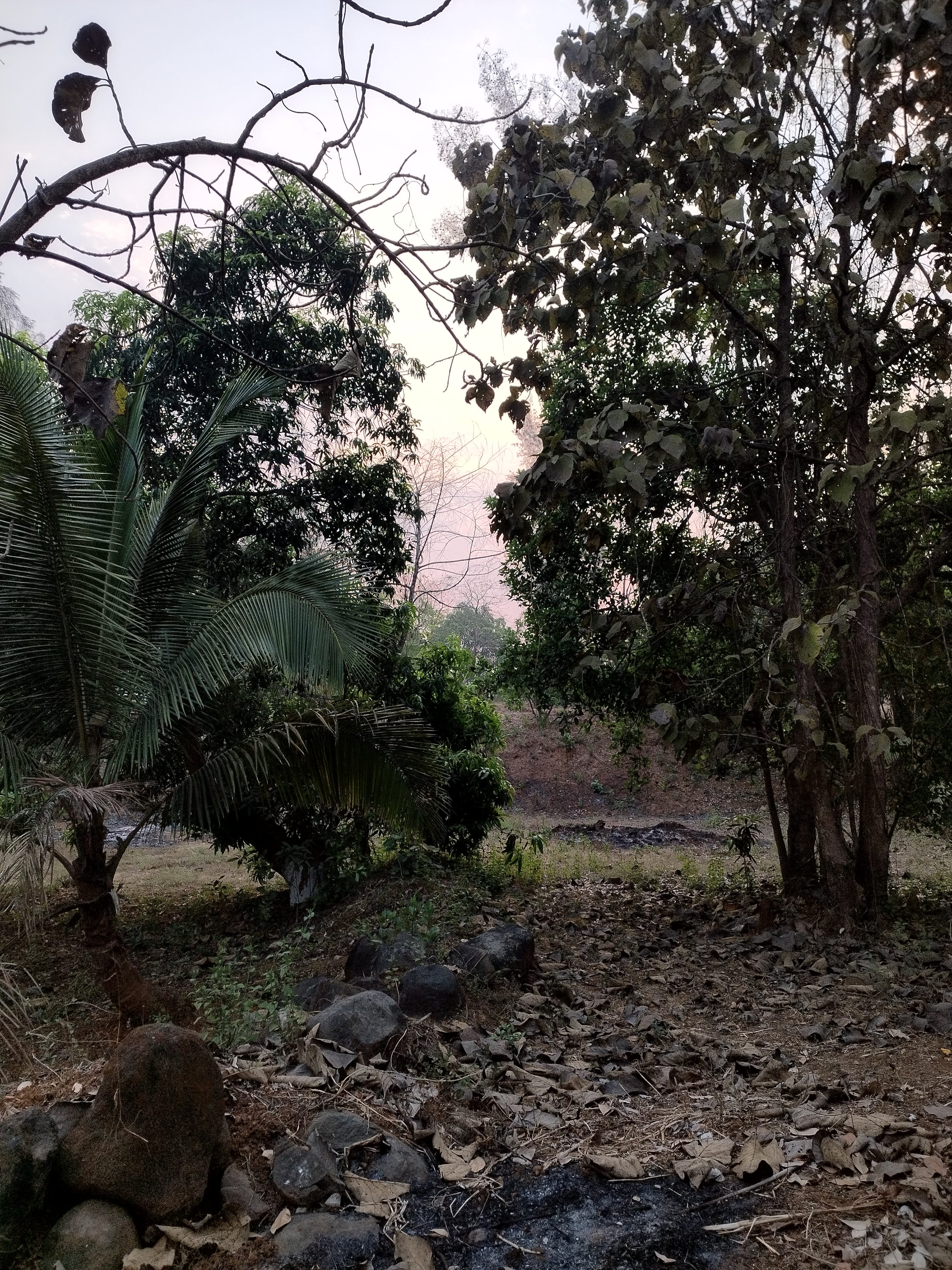
Sometime during that storm, the electricity to my land disappeared.
At first, nobody seemed particularly concerned. Power cuts after, during & before storms are routine here. “It’ll come back,” everyone assured me with the calmness of people who had long ago accepted that infrastructure, much like weather and extended family, cannot be negotiated with emotionally.
It did not come back.
My first instinct, naturally, was to approach the situation logically. Professionally. Efficiently.
This confidence lasted nearly a full day.
Because for quite some time, nobody even seemed entirely certain what the actual problem was. The electricity had gone sometime during the storm, yes, but the exact reason remained floating somewhere in the realm between informed speculation and collective intuition. Eventually, it was explained to me that a tree had probably fallen over the supply line.
Or perhaps multiple trees. Somewhere out there.
Nobody appeared particularly troubled by the lack of precision. The tree existed philosophically. That seemed sufficient for now.
And though nobody had actually seen the tree yet, everyone spoke about it with the confidence usually reserved for weather systems and troublesome relatives.
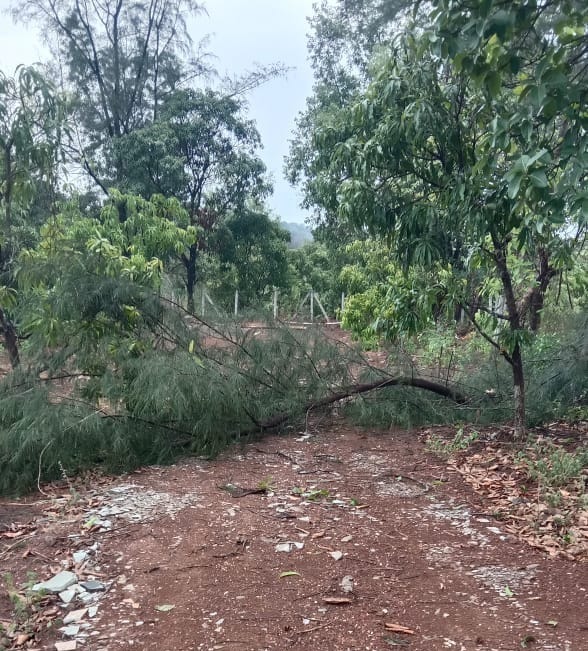
Rural India often operates with an extraordinary tolerance for ambiguity. There is usually enough information for everyone to broadly understand the situation, but rarely enough for anyone to confidently produce a flowchart.
A tree had fallen on a power line somewhere.
Therefore:
the location of the tree had to be identified,
the obstruction had to be cleared,
the line had to be repaired,
electricity would return.
Simple enough.
This was the point at which India, as it often does, gently placed a hand on my shoulder and reminded me that I understood absolutely nothing.
Because very quickly, I learnt that the issue was not the fallen tree itself. The issue was who would remove it. Who would ask them to remove it. Who had already asked them. Whether they were local enough to care. Whether somebody had unknowingly offended somebody else. Whether the request had travelled through the correct social sequence. Whether the lineman felt respected. Whether somebody else felt the lineman had not been respected enough. Whether the office had been informed before the ground staff. Whether informing the office before the ground staff itself constituted a small diplomatic incident.
This country is not for beginners.
It is also not for veterans.
At some point, after nearly two days without electricity, I made what I assumed was an entirely reasonable decision. I directly called the senior official at the electricity office - the saheb sitting some 18 kilometres away, in what I can only describe as the administrative Himalayas - without first informing the local lineman handling the actual situation on the ground.
This, I would soon discover, was an error. Not officially. Socially. Which in India is often the more important category.
Nobody shouted. Nobody argued. Nobody even explicitly expressed annoyance. Instead, I was treated to something far more sophisticated: a slow, almost artistic demonstration of where power actually resided.
Formally, the saheb outranked the lineman. Practically, the lineman controlled reality.
And reality, for the next little while, remained without electricity.
Somewhere during this process, people also began gently explaining to me — always politely, never accusingly — that as an outsider there would naturally be some reluctance amongst the absolute locals to immediately mobilise around my problem. Nobody says “no” here. Rural India has perfected a far subtler mechanism.
Time itself becomes the refusal.
Nobody declines responsibility directly. The responsibility is simply allowed to age gently in the sun.
“Yes, yes, we’ll see.”
“Tomorrow.”
“Someone will come.”
“It’ll happen.”
“Someone will come.”
Nobody specified from where, in what condition or with what emotional commitment to the task.
And slowly, if you are new enough, you begin learning to hear the hidden meanings underneath apparently agreeable sentences.
What I was really being introduced to, I think, was the fact that rural India — and perhaps far more of India than we urban people comfortably admit — does not actually run on systems. At least not in the clean, linear, procedural sense we like to imagine.
Now, to be fair, most Indians already understand that relationships matter. We are not strangers to the idea of “knowing someone” helping move things along. The entire country operates, to varying degrees, on networks, influence, introductions and access.
But rural India adds so many additional layers to this equation that the usual urban confidence of “Do you know who I am?” or “I know someone important” starts becoming strangely ineffective.
Because here, importance itself becomes hyperlocal and deeply contextual.
The senior officer matters. But so does the lineman.
The lineman matters. But so does the local villager willing to help identify the fallen tree.
The villager matters. But so does the person who can persuade the villager.
And all of them exist within older equations of kinship, geography, caste, familiarity, reputation and history that an outsider may not even be aware of yet.
Very quickly, you realise that brute authority alone achieves very little here. What actually matters is social calibration. Knowing the choreography. Knowing who must be greeted first, whose tea must not be refused and which complaint can survive being voiced publicly. Understanding whose ego must remain intact for the larger machine to keep functioning peacefully.
It runs on relationships.
On knowing who to call.
On understanding who should have been called first.
On invisible hierarchies.
On accumulated goodwill.
On tact.
On patience.
On not embarrassing people publicly.
On understanding that efficiency is often secondary to social equilibrium.
And once you begin seeing this, you realise that even something as apparently straightforward as restoring electricity after a storm is actually held together by an astonishingly informal network of knowledge and labour.
At one point, it was casually explained to me that some adivasis would probably need to be brought in to properly clear parts of the route around the supply lines. I remember innocently suggesting that perhaps the workers currently repairing a small structure on my land could help instead. This suggestion was dismissed almost immediately.
“No, no,” I was told. “It has to be them. Nobody climbs trees like they do.”
This was delivered with the calm certainty usually reserved for discussing mountain goats and monsoon patterns. The matter was considered entirely obvious.
And that stayed with me. Because beneath all our official systems and organisational charts exists another India full of deeply specialised knowledge that rarely appears on paper but quietly keeps enormous parts of the country functioning. Terrain knowledge. Climbing skill. Forest familiarity. Social negotiation. Practical improvisation.
None of it formally acknowledged enough. All of it indispensable.
I’ll admit that this part made me slightly uncomfortable initially.
Like many urban Indians of my generation, I carry around a somewhat uneasy relationship with the deeply layered social structures that continue to shape life in this country — caste, community, inherited roles, insider-outsider dynamics and all the invisible codes that come attached to them. I like to imagine I stand outside these things now. Modern. Rational. Detached.
And yet, the further you move outside your own demographic bubble in India, the harder it becomes to maintain the illusion that these structures have disappeared. They haven’t. They’ve simply evolved into forms that are often subtler, more negotiated and far more entangled with everyday life than most comfortable urban conversations are willing to admit.
So when I was told, quite matter-of-factly, that “adivasis” would need to be brought in to clear the route around the electricity lines, my first instinct was discomfort. The categorisation itself felt strange to me. Reductionist, almost.
But the more I listened, the more I realised that what I was hearing was not dismissal. It was respect.
Not the polished, performative respect of corporate diversity panels or Instagram activism. But something older, more practical and more deeply rooted in lived dependence.
The implication was simple: these were the people who knew this terrain best. These were the people who could climb those trees safely, move through that landscape confidently and do the work others could not. Everybody involved seemed to understand this instinctively.
I alone was standing there trying to convert lived reality into a sociology essay.
And that, I think, is the thing I keep bumping into repeatedly out here — this wonderfully confusing Indian ability to be simultaneously welcoming and suspicious at the exact same time.
You can be treated like family and an outsider in the same conversation. Occasionally in the same sentence.
The very network that initially makes you feel mildly unwanted is also the one that eventually rescues you. The same invisible social machinery that preserves boundaries and hierarchies is also carrying around enormous reserves of generosity, loyalty, competence and mutual obligation. It is equal parts support system, labyrinth and extremely affectionate hostage situation.
People will feed you alarming quantities of food, make twenty-seven phone calls on your behalf, explain local politics to you using diagrams drawn in red मिट्टी with sticks, invite you home for tea, fruit, lunch, second lunch and something called “just snacks” that could sustain a small infantry unit — and yet, all the while, gently remind you that you are still new here.
That there are older equations at play. Older rhythms. Older loyalties.
You begin to realise that belonging here is not ideological. It is social. Slowly accumulated. Like recurring deposits of goodwill made into an account whose rules nobody fully explains to you.
And honestly, I still can’t fully decide whether this entire system is beautifully humane or completely exhausting. Most likely both. Which, now that I think about it, may also be the most accurate description of India itself.
By the third day, I had lost track of whether we were restoring electricity, preserving social harmony or participating in an elaborate community theatre production about infrastructure.
Eventually — after five full days, several storms of speculation, countless phone calls, strategic silences, wounded egos, patient negotiations, local intelligence, social diplomacy and what I can only describe as spiritually advanced levels of follow-up, involving phone calls that seemed to operate simultaneously as negotiation, emotional reassurance and weather forecasting - the electricity returned.
Not dramatically.
There was no cinematic moment. No victorious switch being flipped. One evening, quite casually, the lights simply came back on, as if the entire village had collectively decided the matter had now received the correct amount of suffering and character development.
By then, the restoration itself almost felt secondary to everything the process had revealed.
The electricity did not return because I filed the correct complaint. It returned because a lineman from another beat helped, because my local friends made the right calls to the right people in the right sequence, because somebody persuaded somebody else without bruising their ego, because patience was exercised where aggression would have failed and because, eventually, the larger social organism decided to cooperate.
Which, I am beginning to suspect, is how an alarming amount of India continues to function.
Somewhere towards the end of all this, the now-famous VIP lineman — whose position in the local cosmic hierarchy I had accidentally underestimated earlier — invited me to a bhandara at his home.
I found this deeply funny. And more bizarrely, illogically logical.
Just a few days earlier, I had been sarcastically reminded that I had called the wrong person in the wrong order. I assumed I had caused some major social rupture. Apparently not.
People here seem to possess a far healthier relationship with friction than we urban folk do. Egos wobble briefly, sarcasm is deployed, somebody establishes authority and then everyone simply moves on with life. As long as something is not done with genuinely malicious intent, nobody appears particularly interested in carrying emotional residue forever.
They are already navigating lives layered with such complexity and interdependence that somewhere within it all, things become oddly simpler.
And so now, naturally, the entire episode appeared to be concluding with food.
Which, when you think about it, may actually be the most Indian ending possible.
And perhaps that is the thing I am slowly learning, as I stumble my way through this new chapter of land, orchards, villages and rural infrastructure.
Beneath all the chaos, inefficiency, contradiction and exhaustion lies an extraordinarily dense human web. One that can support you, rescue you, feed you and guide you. But also one that can confuse you, delay you, test your patience and occasionally leave you feeling gently trapped inside its endless negotiations.
It is affectionate. Territorial. Generous. Suspicious. Humane. Exhausting.
Sometimes all before tea.
And perhaps, that, is the strange, faintly terrifying genius of this web — the very machinery that eventually solves your problem can also exhaust, confuse and smother you so thoroughly, that quitting it all stops feeling emotional and starts feeling like the only rational option.

Thank you!
Fascinating! There are levels of this actually everywhere, just not always in charge of infrastructure. I really appreciate hearing about all your "adventures in daily life", thank you.